I sometimes have to wonder if writers realize the awesome power they possess. When wielded correctly, it can be an amazing force that influences people. When wielded in a reckless and bullying fashion, it makes you look like an idiot. This is magnified even more when writers come together as a group to condemn another.
I saw this when I got the latest edition of the Navajo Times sent to my email on Thursday. A group calling itself Saad Bee Hozho wrote an opinion piece attacking author Rebecca Roanhorse, who published a book in July titled Trail of Lightning. Saad Bee Hozho declared the book to be an appropriation of Navajo culture and claimed Roanhorse did not have the authority to use Navajo beliefs and teachings in the crafting of her book.
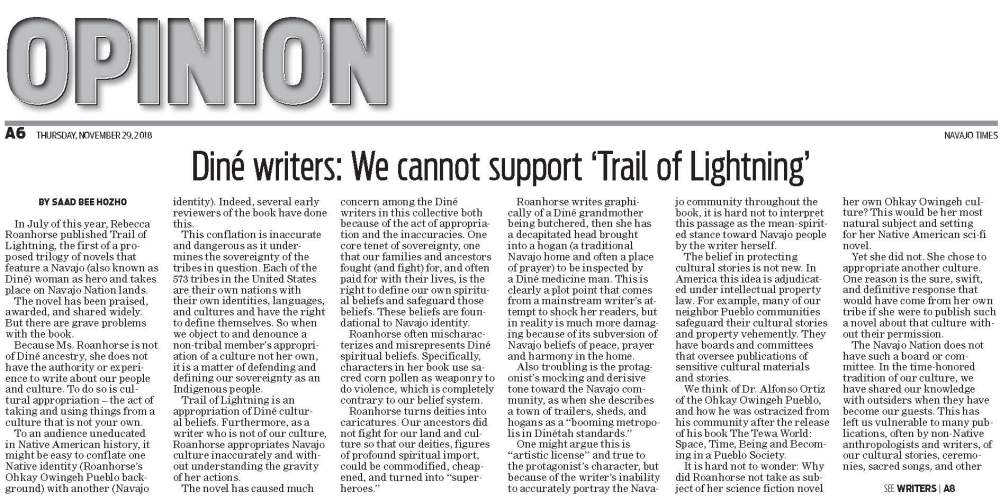 Some background before I dive into my argument: Trail of Lightning is a post-apocalyptic tale that puts a Navajo woman in the role of a monster hunter with an unconventional medicine man. Roanhorse is not Navajo by descent; her tribe is the Ohkay Owingeh Pueblo. The Saad Bee Hozho, originally called the Navajo Writers Association when it formed in 2016, has collectively condemned the book because it feels the only ones suited to write about Navajos are Navajos.
The group wrote in its column, “Who can write about Navajo people, who can set their stories in Navajo lands, in Navajo hearts and minds? Our ancestors fought to keep our land, so we could define ourselves and live as we saw fit. Our answer is, the right to define us belongs to Navajo people.”
I’m going to call bologna on this one. While it’s certainly true that the best storytellers draw on their own experience and culture, there are talented writers than can take key points from different walks of life and spin fascinating tales. While there certainly are writers who actively try to portray indigenous people, religious groups, certain races and others in a negative light, most try to bring out the best in their characters and their beliefs.
If you write only about people and things that are purely connected to your own culture and values, you’re going to wind up with some pretty segregated tales. My books would consist purely of all white people and take place in Chino Valley and Prescott, Lake Powell, and Shawano County. That would certainly limit the imagination.
I could understand the outrage if the author were claiming her book was true to life, but it is science fiction, a genre long known for bending the rules of reality and making the impossible commonplace. You’re not going to create a world of wonder and amazement in this genre without sticking reality in a blender and turning it on high for about two minutes.
I’ve been working on a book off and on for several years that fits in the science fiction and fantasy category. I’ve crafted the heroic guardian that’s one of my main protagonists with similarities to a Scottish warrior, even wearing the traditional kilt, and I’ve created the main city to resemble a Japanese palace. Should I expect scorn and anger from both sides of the planet because I utilized the fashion and architecture from their past?
I understand the sensitivity of native tribes when it comes to the loss of their identity and their ancient treasures. I enjoy learning of their history and what they believe, because once you understand a people, you’re more likely to find some common ground between you and them. With many writers, the question “What if?” takes their imaginations beyond the established boundaries, and that is something that should be celebrated.
Saad Bee Hozho doesn’t want to celebrate it; the group wants to condemn it. The organization is quick to point out in its column that it “brings together Diné writers to develop literary culture on the Navajo Nation, to discuss issues in Diné literature, to share our work with one another, and to mentor the next generation of Diné writers.”
However, the group also indicated it wants the Diné to almost become isolated when it comes to sharing who the people are culturally and spiritually. Saad Bee Hozho said, “In the time-honored tradition of our culture, we have shared our knowledge with outsiders when they have become our guests. This has left us vulnerable to many publications, often by non-Native anthropologists and writers, of our cultural stories, ceremonies, sacred songs, and other cultural material that should never have been published for a non-Navajo audience.”
The group cited Tony Hillerman, acclaimed mystery writer, as an example. Hillerman wrote mysteries that took place on the Navajo reservation, and they included Navajo protagonists that were shown in a positive light. According to Saad Bee Hozho, Hillerman is just as guilty of Roanhorse of figuratively raping the Navajo culture. Only Navajos are allowed to write about Navajos, the group believes.
I haven’t read Trail of Lightning, and I have no idea whether it’s a brilliant work of literature or, as the Saad Bee Hozho believes, a hatchet job on the Navajo people. However, I think it should be up to individuals to criticize or praise. To come together as a group and pass judgment on a book and/or author is nothing short of bullying.
I have been part of a writer’s collective for almost eight years, the Shawano Area Writers, and while we’ve always been forthright and honest when we’ve felt someone’s work might not be heading in the right direction. Even so, none of us have ever felt the need to get the group to endorse censorship, to claim to be the true authority on what is right or wrong to put in a book or to make assumptions that what someone has written is an affront to every member of our community.
I highly doubt that Saad Bee Hozho’s ratified objection is going to make much of a dent in Roanhorse’s book sales, and considering how much curiosity outraged outbursts like this one generates, it might even encourage more people who had otherwise never heard of Trail of Lightning to grab a copy, just to see if the outrage is justified. Maybe next time, the members will stick to lifting up their own writers and not waste time condemning others. When it comes to it, we all bleed the same—black ink.

 Rural Roots and American Rainbows